
On March 11, 2011, an earthquake struck off the coast of Japan’s Tohoku region, triggering the most destructive tsunami in the nation’s recorded history. The tsunami leveled towns and swept coastal neighborhoods out to sea. Amid the onrush, people fled their homes and lives as they had known them. For the communities razed, reconstruction efforts persisted for years. The tides eventually abated but, for the families haunted by loss, the trauma endures.

It may be impossible to feel the full weight of such devastation unless we’ve experienced it ourselves. I remember being glued to news coverage of the catastrophe as it unfolded. Yet for all the footage of tidal swells and debris where communities had just thrived, the devastation felt eerily distant. The personal and emotional tolls receded from the social media algorithms and cable news chyrons a half-world away.
But what if other mediums can do better? What if the more personal, interactive nature of video games can help fill gaps that the numbing content churn leaves empty? What if — by immersing players in the plights and perspectives of those who might endure such horrors — they can gamify empathy?
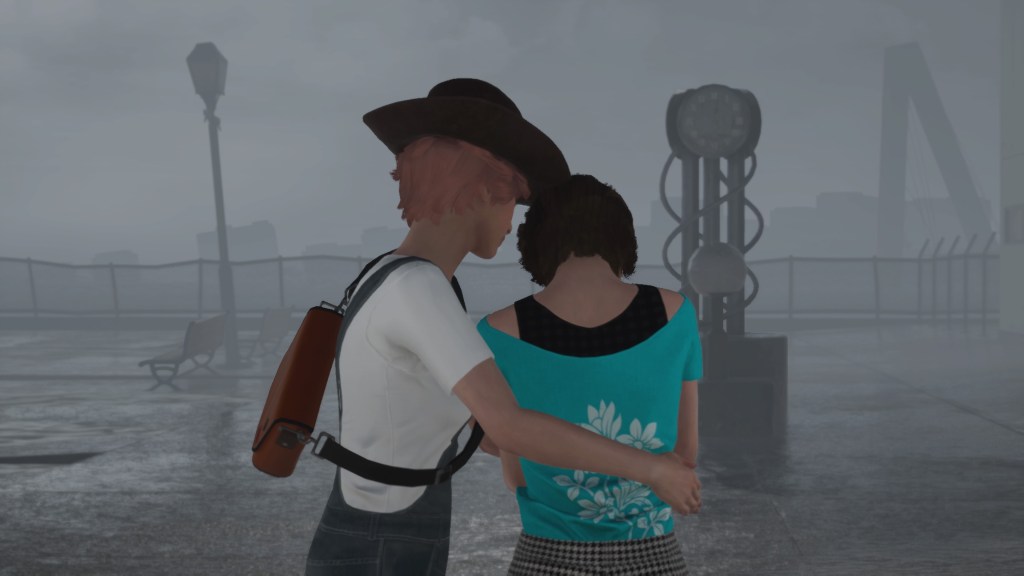
Gearing up for the next entry in its natural disaster-themed game series, Irem was mere days from releasing Disaster Report 4: Summer Memories when the Tohoku earthquake and tsunami struck. Hitting close to home in every sense, Irem shelved the would-be PlayStation 3 title and dissolved its ailing game development studio. This would conclude a several-decade run.
A few years later, the development team — resurrected as Granzella Inc. — would find a new generation and context for the game. Disaster Report 4 eventually landed on Japanese PS4s and Switches in 2018 and 2019, respectively, and in April 2020 worldwide. Swapping one disaster for another, the early pandemic made for only nominally better timing but at least it gave folks another thing to do between exploiting the turnip economy and tossing suspicious friends out of airlocks.

Admittedly, I haven’t yet played the previous entries in the Disaster Report series, known in Japan as Zettai Zetsumei Toshi (rough translation: “Absolute Death”). Disaster Report 4 thrusts players into a disaster-ravaged locale and bids them to survive somehow. Players must mosey through the urban ruins crumbling around them, while aiding others whose lives have been upended. Its premise pays homage to the B-movie disaster genre, while its style of play falls somewhere between an adventure game, a visual novel, and a walking sim. The game borrows elements from each style — with a tonal paradox akin to the dramatic zaniness of Sega’s Yakuza/Like a Dragon series — for a unique vibe all its own.
In your personalized protagonist’s shoes, you’re always on the run. You must search for ways to escape the aftermath. Amid the catastrophe, you’ll brace for aftershocks, dodge toppling skyscrapers and overpasses, accessorize with an assortment of compasses, backpacks, and outfits scattered about, and assist (or be an asshat to) your fellow survivors. You’ll complete fetch quests and escort folks to safety, and relish in their juicy personal drama. There are also survival elements to manage — hunger, thirst, stress, and your bladder — but ignoring them is largely inconsequential.

Through its play, Disaster Report 4 imposes its chaos on the player with extreme ambivalence. Its ruined world can be neither saved nor conquered, and players are afforded just enough agency to cope. In the company of other survivors, the game finds a breadth of stories to tell — all at once personal, tragic, endearing, and a bit messed up.

As I’ve struggled to describe Disaster Report 4 over these last few paragraphs, I’ve realized Illbleed (Dreamcast, 2001) might be a close-ish parable. Like Shinya Nishigaki (R.I.P.) and Crazy Games’ pulp horror-inspired virtual theme park, Disaster Report 4 plods with a deliberate cadence. Both simmer in suspense a la film’s schlockier genres. Their settings harbor uncertainty around each corner and give little quarter from environmental traps and deadly set pieces. Both demand vigilant attentiveness and leaps of faith. They force players to depend on intuition they can never fully trust, and caution — over combat — to survive.
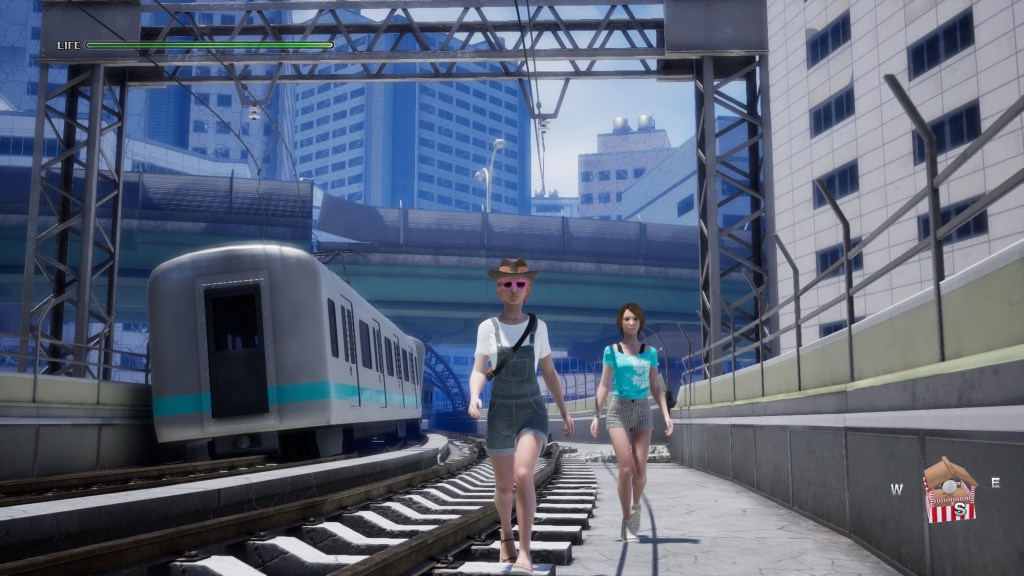
I was initially hesitant to play Disaster Report 4 following its lukewarm reception. Critics and players condemned the game for its array of issues spanning its repetitive play loop, stifling linearity, nebulous progression triggers, and choppy, PS3-esque visuals. I certainly understand those points of friction and I’ll take people’s word that its predecessors were better games. In all, I found these issues seldom detracted from its empathetic core.
Flawed as it is, Disaster Report 4 is a remarkably human video game. As modern applications of gen AI race to strip creative media bare of its meaning and humanity, I was unprepared for how charming and weird — and at times heart-wrenching — the game would be.

At the outset, Disaster Report 4 asked how I would act in a disaster scenario. It presented several options spanning flavors of selfless heroism, unabashed selfishness, paralyzing indecision, and points in between. But really, the game posits, I wouldn’t actually know until faced with such horrors myself.
Even as it trudges through tragedy, Disaster Report 4 wallows in whimsy. And the range of behavior and dialogue choices inflame the tonal incongruence. As I encountered other survivors, I found I could help them, of course — or mock them, extort them for money, and begrudgingly help them anyway. And if I thought love can bloom even on the battlefield rubble, the game let me awkwardly romance certain NPCs provided I was insensitive and horny enough. Or I could just bark at everyone to fuck off. And I could do it all while wearing a maid outfit and/or Power Ranger suit.

My decisions yielded amusing and hilarious consequences, though often only in my head canon. And over time, those inferences shaped my personal role play experience more tangibly than the “branching” narrative. In reality, the game presented an illusion of choice amid a (mostly) linear sequence of plot events.
The journey began, mundanely enough, on a bus. Suspense swelled as passengers’ phones erupted into a haunting cacophony of emergency alert jingles. Everyone froze, oblivious to the fate that will soon befall them. That moment of sheer confusion was my glimpse into the precipice of apocalypse. Normalcy’s last gasp. Seconds later, the big one hit.

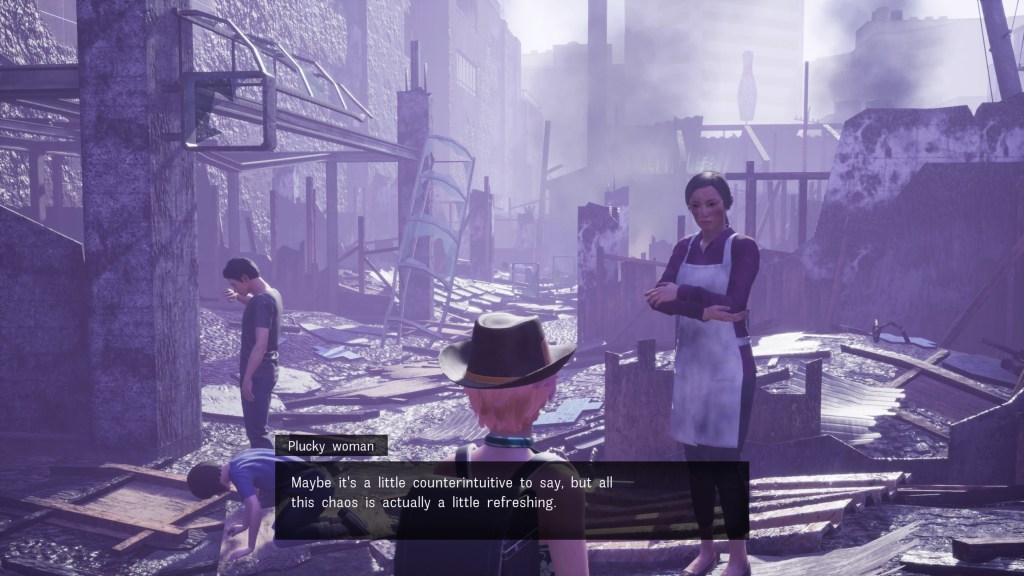
My character awakened among the disheveled masses, bound by walls of debris and communal panic. I could talk to nearly every NPC, and quickly leaned on their hardships to anchor the emotional stakes of the disaster. Most were shocked and terrified. Some focused on immediate survival, pondering whether death was less assured in an open park or under cover of structures that could — and often did — collapse in any instant. Some frantically searched for friends and loved ones. Some risked their own safety to help complete strangers. Some tried to salvage any remnants of their daily routines claimed by the debris. They lamented how the collapsed roads and overturned traffic would make them late to work, desperate for something to still be late for.
Disaster Report 4 explores the ways we process, grieve, and cope with our sudden loss of normalcy. It presents desperate situations through disparate perspectives to understand what such loss means for each of us, together. And in that sense, perhaps Disaster Report 4 was the perfect game for its time.
Up to this point, I’ve tried to keep things reasonably generalized but I’m losing the will to avoid spoilers. Fair warning.

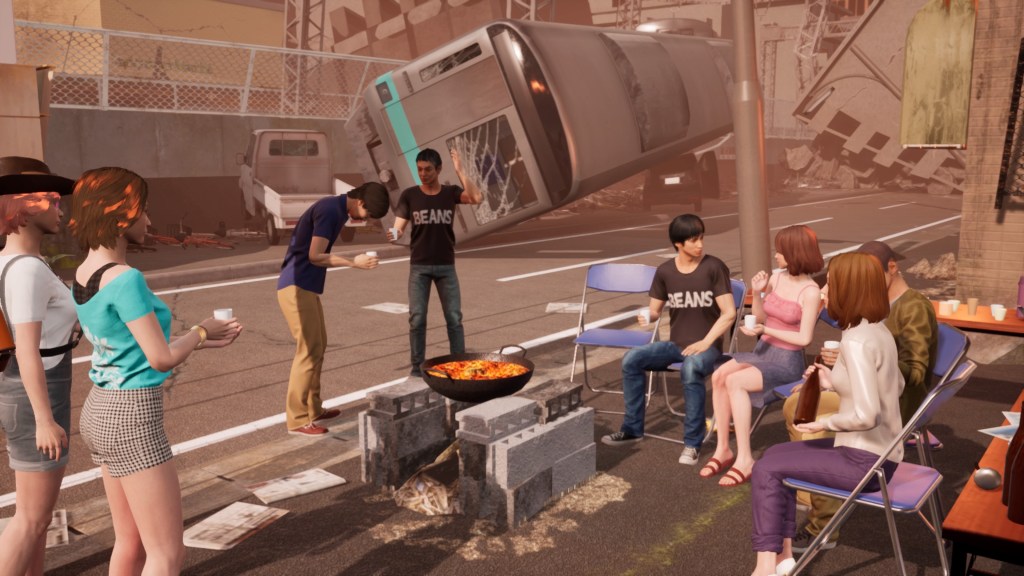
Narratively and structurally, Disaster Report 4 played out like a series of slice-of-life vignettes amid the turmoil. The opening act shoved me into the terror and uncertainty of a society deteriorating in real time. As I witnessed — and endured — its descent, the mid-game slowed to a simmer. The tension eased into mundanity as I helped console and mend communities in whatever small ways I could. In the final act, the collective efforts of residents, humanitarian workers, and construction crews helped set the city’s gaze toward rebuilding and the challenges ahead.
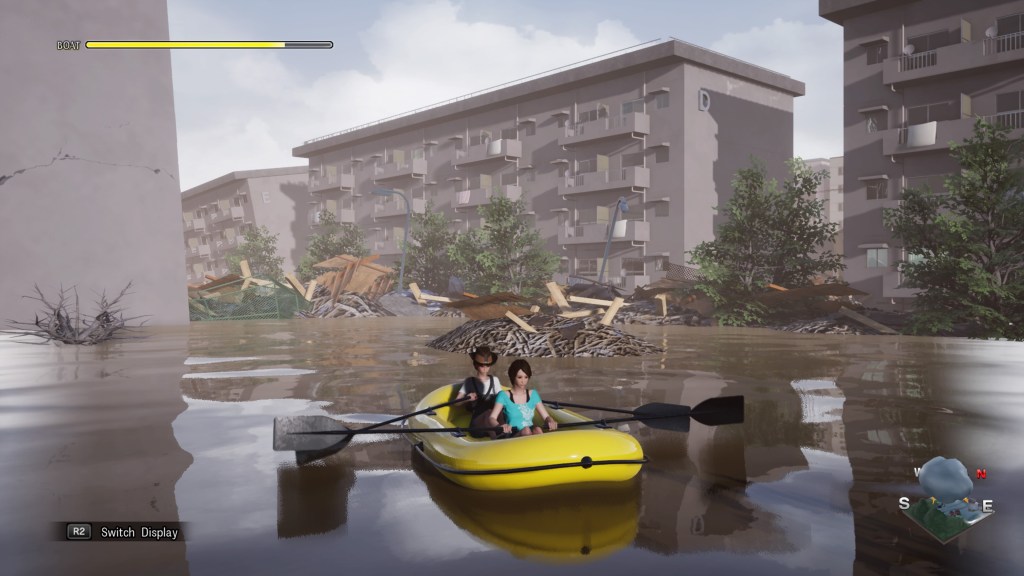
The narrative jostled between heartwarming, unsettling, and absurd. In the emotional whiplash, many of these moments stuck with me. At one point, my companion and I rafted through a flooded apartment complex, relieved to find a mother and her children who kindly took us in for the night. We planned to escape together at dawn, but the family fell behind. We vowed to rendezvous outside but, just as we boarded our raft, the building collapsed and they were swallowed by the sea. My character’s desperate calls to the void (via the Triangle button) would be the closest I’d come to saying goodbye. I was gutted.
Despite the shared turmoil in Disaster Report 4 — or perhaps emboldened by it — folks did some wildly unscrupulous shit. Myself included.
Even in my goody goody playthrough, I learned sometimes my best intentions were inevitably calamitous. In one scene, I invited some of the city’s most vulnerable and desperate survivors to take refuge in the comforts of my cult. I know that sounds ghoulish — but in my defense, I thought it was more like one of those fun cults. I never suspected it was a cult cult. We had wine and hors d’oeurves and air conditioning, which paired nicely with the salvation.

Later, I accidentally duped a shelter full of NIMBYs into worshipping me and my bottle of “magic” all-curing water, which I kept filling from a gutter nearby. When they realized the scam, they hunted down and battered my friend. They tried to get me too, of course, but I was the faster runner.
In my second playthrough, I just said “fuck it” and embraced my worst self. I routinely mocked people for their misfortune and gouged them for every little favor. Harnessing my early pandemic energy, I charged someone 2,000 yen for a roll of toilet paper. Then I sold a band-aid for 300,000 yen. If I were a provider in the American healthcare system, I’d fit right in.
Ultimately, this was not an especially satisfying way to play Disaster Report 4.

With every misdeed — intentional or not — the game subtly but deftly made me feel like a total prick. NPCs suffered so thoroughly and in myriad ways, I felt no joy in making their lives even more difficult.
Characters didn’t always acknowledge the fact I insulted and/or extorted them, and the authored narrative left limited space for them to react. Practically, this reflected a lack of dynamism, with fewer outcomes to accommodate all the dialogue possibilities offered. But effectively, whenever characters ignored or downplayed my bullshit, they simply deprived it of relevance — and me of relevance — amid the greater devastation they had to overcome. I was left holding clumps of their yen in one hand and crushing guilt in the other. An intrinsic twisting of the knife.
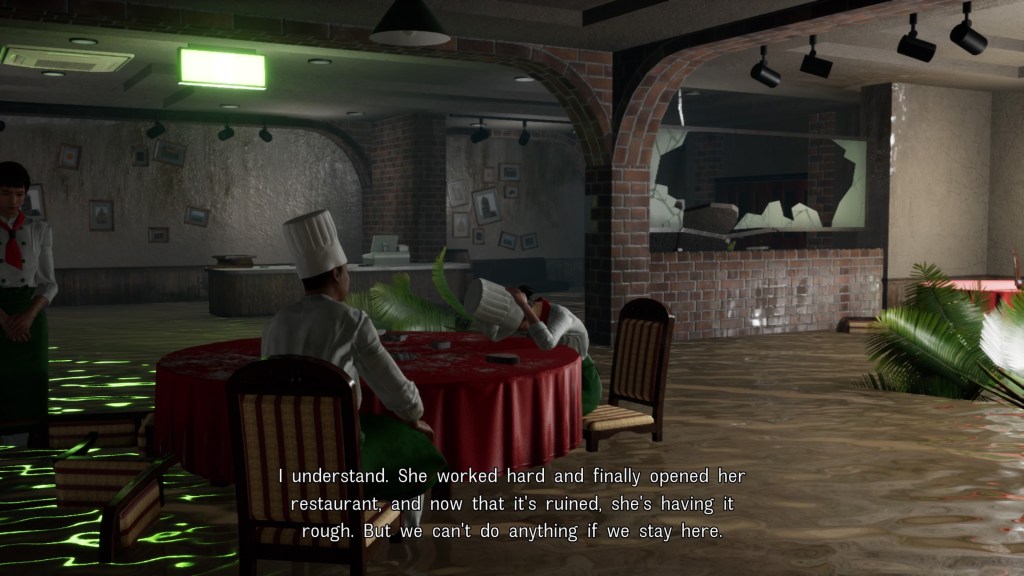
Of course, I’m far from the only asshole in Disaster Report 4. More often, the chaos simply stirred up the demons already in our midst. I encountered grifters and thieves taking advantage of the situation but also more insidious, normalized depravity. Corporations exploited the chaos as cover for espionage and slander campaigns — while accusing their rivals of doing those things enough to justify escalating it themselves. (So, business as usual, I guess.) In another sequence, I came upon a historic hotel that was fully ablaze. A crowd of onlookers mourned its loss to the community while snapping the perfect Instagram pics for optimal virality.
For everything the earthquake destroyed, the worst plagues of our greed, xenophobia, and vanity thrived atop the liquefied soil.

Disaster Report 4 explored a breadth of themes through individual and collective strife, and depicted the tolls of the disaster more personally, earnestly, and messily than I had expected. Although the game didn’t always hit the emotional highs and lows it aimed for, it certainly succeeded enough as a thoroughly personal and memorable experience.
After the credits rolled, the game once again asked what I would do in the face of disaster. For me, that question remains unanswerable. However, Disaster Report 4 imparted valuable insight into what it might have meant for the victims of Tohoku and other communities who have suffered similar disasters. The game gave me a shockingly personal window into their courage through calamity. More than wall-to-wall news coverage, tsunami video compilations, and viral images of the aftermath, it helped make such unimaginable devastation feel a little more imaginable.

 The Virtua Planet